
Fixing the Global Canvas: What Pixart.world Does Differently from Wplace and r/place

TL;DR: Collaborative pixel art shouldn't feel like an endless chore of fixing vandalism, nor should it require a team of moderators constantly scrutinizing every corner of the map just to keep it clean. I built Pixart.world to solve these systemic flaws. By making artworks inviolable, we’ve created a safe space where you can focus on creating, not defending, and completely removed the need for excessive micro-moderation.
There is something oddly addictive about placing a single colored square on a canvas shared by millions.
It started as an experiment that became a cultural phenomenon. When r/place first launched, it didn't just capture the internet's attention, it created an entirely new genre of social interaction. It proved that pixels can be the universal language of the web, and it birthed a collective obsession with digital territory, community defense, and collaborative murals.
But r/place was just a sprint - a 72-hour burst of beautiful chaos organized only once every few years. This left a massive global community of creators craving a permanent home once the canvas finally faded to white.
The logical next step was turning that sprint into a marathon. Many platforms took the concept and applied it to a literal “global” stage, most successful among them being Wplace. Launched in July 2025, they reimagined the scale entirely, moving from a tiny, confined square to a staggering 4 trillion pixel canvas mapped directly onto the physical world. For the first time, you weren't just fighting for a spot in a random grid; you were claiming your hometown, your country, or building a sprawling pixel empire across the digital Atlantic.
The demand for this "forever canvas" was unprecedented. In less than two months, Wplace became a global sensation, attracting over 10.6 million users eager to carve out their own corners of the digital earth.
It was a commendable leap forward. However, as the canvas expanded to trillions of pixels and the timeline stretched toward infinity, the structural cracks began to show. The "Global Canvas" started facing systemic problems that the original r/place has never struggled with.
The Griefing Dilemma: Why the "Global Canvas" is Breaking
The most burning issue facing platforms like Wplace today is griefing (the deliberate vandalism of others' art) and the desperate struggle for anti-griefing measures.
Wplace shares the same fundamental principle as r/place: there is only one shared canvas for everyone. Whenever you place a pixel, it replaces the old one instantly, no permission required. Because of this, griefing isn't a new phenomenon. It happened constantly during every r/place event. Whether you were trying to build your country’s flag, a community logo, or a meticulously shaded Luffy, there was always someone, or a "void" of black pixels, trying to overwrite it.
However, griefing was never a fatal problem for r/place. The reason is simple: The scale of space and time was condensed. In r/place, the event is a 72-hour sprint. It is entirely fair to expect a community to stay online, focused, and coordinated for those few days. If you fail to defend your art during that window, it’s part of the game. In fact, the "war" between creators and griefers is what makes r/place exciting. Without that conflict, r/place wouldn’t be r/place anymore.
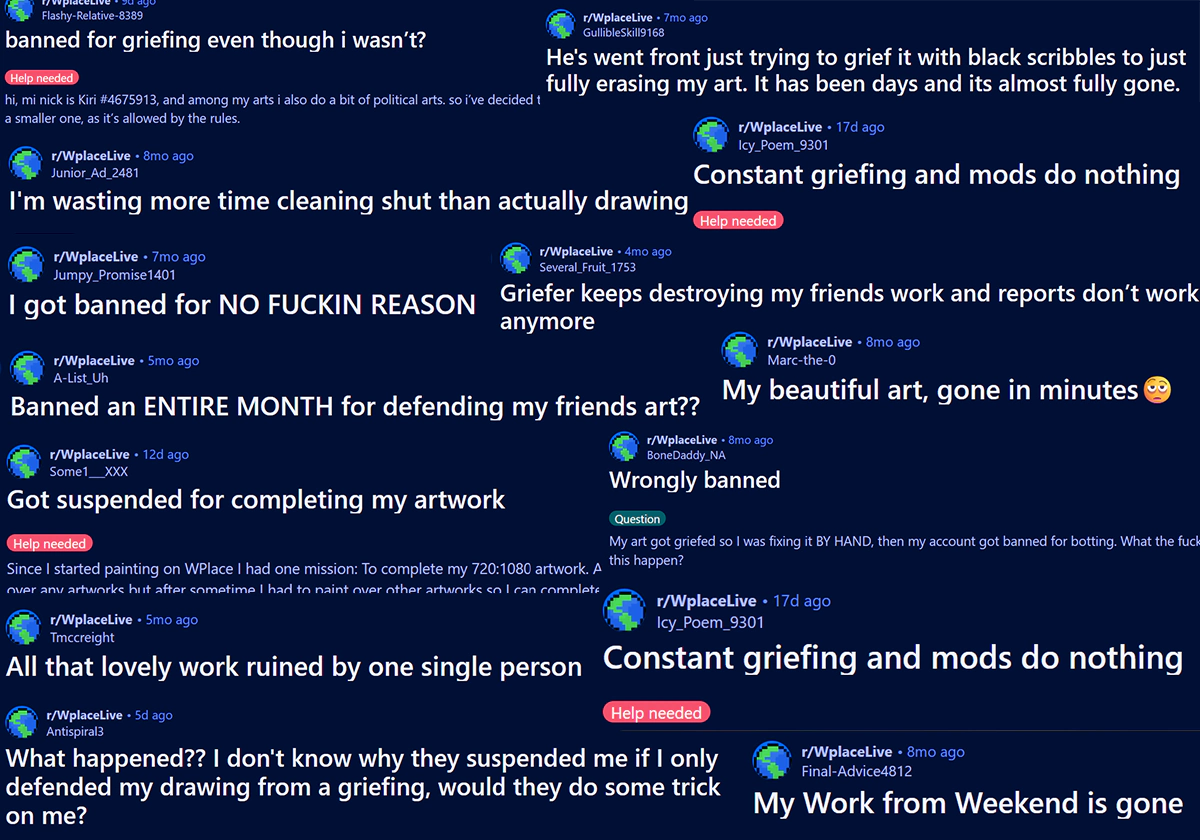
But for Wplace, this mechanism has turned into a storm of frustration. Social media and subreddits are flooded with two seemingly opposite complaints:
"My art was ruined and the griefers weren't punished."
"I didn't grief anyone but I’ve been falsely banned."
Even if not every "innocent" claim is true, the sheer volume of frustration is undeniable. Even now, with active users estimated at 100x–200x below peak levels, a large part of community posts still revolve around the friction between griefing and moderation.
So, why is Wplace struggling with something r/place never did? It comes down to three systemic flaws:
The Infinite Timeline: Unlike a 3-day event, Wplace is infinite. You cannot realistically expect a human being to guard their art day after day, week after week. "Passive maintenance" is an exhausting chore, not a fun game you enjoy.
The Asymmetry of Effort: Because the world map is so huge, artworks are often much more complex and created by fewer people than on r/place. An artist might spend a week of hyper-focus painting a detailed masterpiece, but a griefer needs only minutes to draw a random scribble to destroy it. Griefers have a massive, unfair advantage in the "time-to-ruin" vs. "time-to-create" ratio. This shifts the responsibility of defending artworks from the authors to the moderators team.
The Micro-Moderation Nightmare: It's hard to draw a line between what should be allowed and what shouldn't. You don't want people's hard work ruined, but you don't want the map to be stuck with old art forever either. Wplace's rules on this are notoriously ambiguous and confusing. Moreover, the massive canvas requires an impossible amount of manpower to moderate fairly, even assuming a good-faith effort - a premise many in the community now view with skepticism. Also, because Wplace processes and stores data as individual, disconnected pixels, it is technically difficult to give moderators a "full picture" of an incident. Some ex-mods have alleged (unconfirmed) that moderators have a crude tool that lets them draw a rectangle to erase and ban everyone inside it, nuking griefers, victims, and innocent bystanders alike. If that's not terrible enough, recent signs suggest that moderation may have been outsourced to AI, leading to a wave of automated, sometimes unjustified bans, seemingly without a human ever taking a look.
Finally, there is the Loss of Legacy. In r/place, even if you lose the war, you live on in the viral time-lapse videos of the canvas's evolution. You can be proud that "my art was there at that time." But Wplace is more like a live exhibition; it emphasizes what is currently displayed. Because the scale is too massive for a meaningful time-lapse, if your art is gone today, your hard work is effectively erased from history.
The Pixart.world Solution: Reimagining the Foundation
To solve a broken system, you have to change its DNA. While every other platforms fixate on individual, disconnected pixels, Pixart.world introduces a different atomic unit: the Artwork.
This shift in perspective changes everything. By grouping pixels into a singular Artwork entity, we provide them with context, ownership, and a set of digital rights that the "single-pixel" model cannot support.
1. Inviolable Artworks
This is the most impactful difference. On Pixart.world, your artwork occupies an inviolable space. A random player cannot simply erase or replace your pixels. Only you and those you explicitly invite have the power to paint on your canvas.
This effectively kills the Asymmetry of Effort. You can spend weeks of hyper-focus on a complex, 100,000-pixel masterpiece without worrying that it will be ruined in just minutes while you are sleeping. Your time is respected, and your hard work is protected.
2. The Battle for the Spot
The world is a shared canvas. While your artwork is preserved, the spot it occupies is not. If multiple artists want the same location, they have to fight to keep their artwork on the top layer where it is visible to the world by spending Chroma Droplets (pixart.world’s main “currency”).
The result is a dynamic, competitive map that feels like a battle for visibility rather than a toxic fight for survival. You might lose the "top spot" to a higher bidder, but your art remains intact. You'll never have to rebuild your art from scratch.
3. Contextual Moderation
Storing pixels as separate entities makes micro-moderation a nightmare. By treating them as part of a whole, Pixart.world provides moderators with the full picture instantly.
Hearts and Captions: Because Artworks are social objects, it opens the door for many possible features we can develop around it. You can caption your work to tell its story, and others can give "Hearts" to show appreciation.
No need for "anti-griefing" Rules: Since players cannot overwrite each other's work, the primary source of moderation conflict - deciding what counts as "griefing" - is gone. This removes the need for the strict but ambiguous rules that caused so much confusion and frustration.
For more details, please check out Pixart.world's Frequently Asked Questions.
The Result: A Healthier Environment
This fundamental redesign results in three major shifts for the community:
Vandalism is replaced by Competition: The “territory war” is alive, but stripped away the toxicity. It becomes an auction for visibility, not a destructive street brawl.
The Asmmetry of Effort is gone: Creators no longer have to fight an uphill battle, fixing their hard work endlessly. You can now focus entirely on creation while the defense is guaranteed by the system.
Easier to moderate: Now that “griefing” has been removed from the equation, we don’t need to mess around with the ambiguous ‘anti-griefing’ rules anymore. This, together with the fact that all pixels can now be considered within their context of artworks, will give a much easier time for moderators to do better work. Moderation becomes about quality and community standards, not policing every pixel.
Building a Better Home for the Global Canvas
Pixart.world has just started the open beta. Our world map is still having a lot of space, waiting for the first wave of pioneers. We’ve built a world where your creativity is protected, now we just need the creators to make it home.
Whether you’re a veteran of the r/place wars, a former Wplace user who quitted after being mistreated, or simply someone who wants to claim a corner of your hometown, Pixart.world is ready for you.
Come and leave a mark that actually lasts. The first landmarks are already being placed. It's time to add yours.
Claim your spot on the world map at pixart.world